
ALA News
Planning cooled in October, spending is down from a year ago, and A/E firms are still hiring
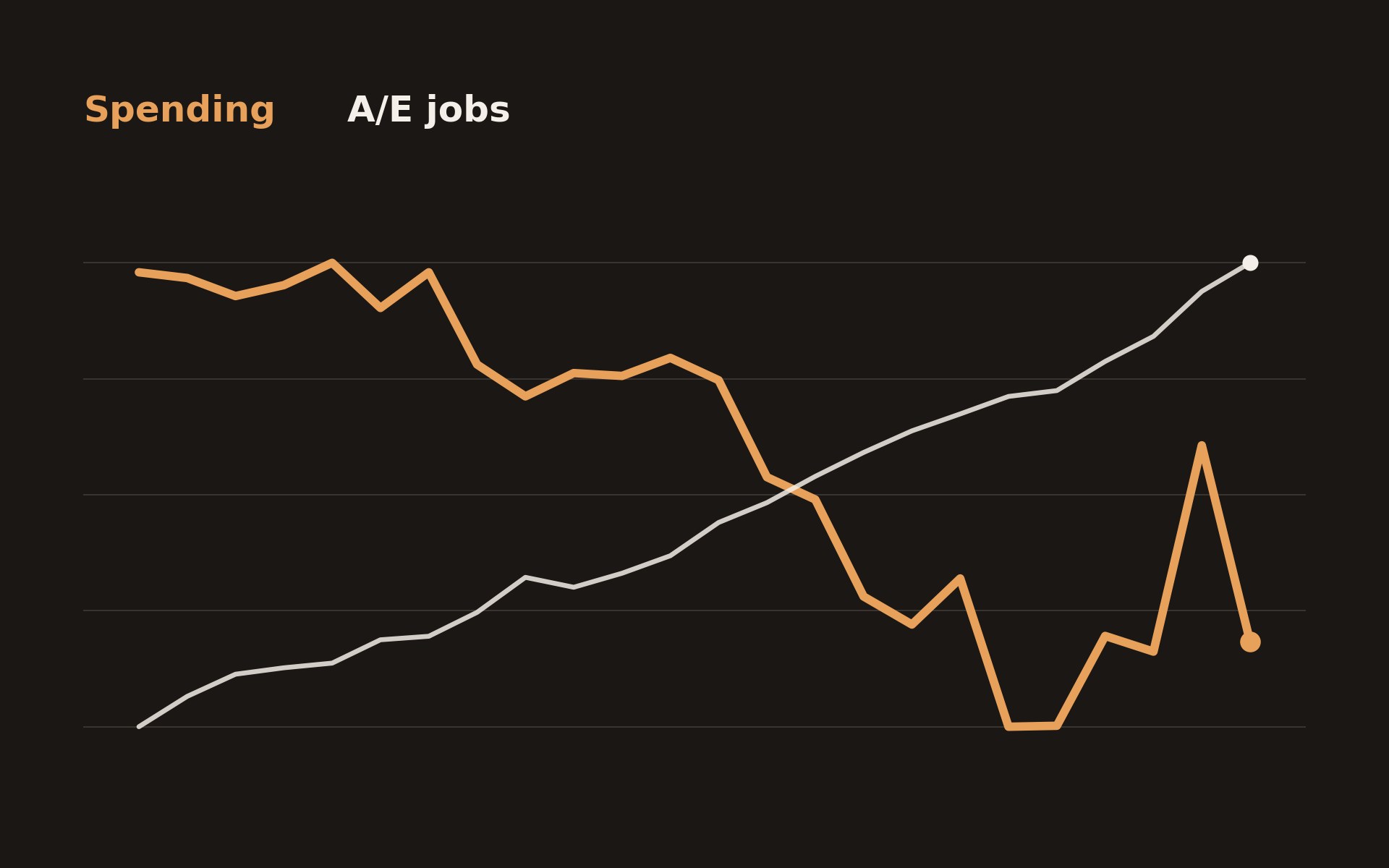
Three public sources tell an architect most of what is coming. Dodge tracks projects entering planning, which is the work that reaches drawing boards and then construction over the next year or so. The Census Bureau measures what is being spent on construction right now. The Bureau of Labor Statistics counts the people doing the work. Here is where each stood as of their latest releases.
Planning: what is coming (Dodge)
The Dodge Momentum Index counts nonresidential projects entering planning. Dodge says it leads nonresidential building spending by a full year to 18 months, so it is the closest thing to a forecast of the work that will reach firms in 2027.
- The index fell 9.0% in October to 260.4. September was revised down to 286.0.
- Commercial planning fell 13.4% in the month and is down 17.6% from a year earlier. Dodge pointed to weaker data center and warehouse planning.
- Institutional planning slipped 1.5% in the month but is up 33.4% from a year earlier. Schools, healthcare and public buildings are holding up better than commercial work.
- 23 projects worth $100 million or more entered planning in October.
Construction starts, the projects breaking ground, jumped 22.8% in October to a $1.633 trillion annual rate. Manufacturing did nearly all of it, led by a $16.8 billion semiconductor plant. Dodge's chief economist said total starts fell 1.1% without manufacturing.
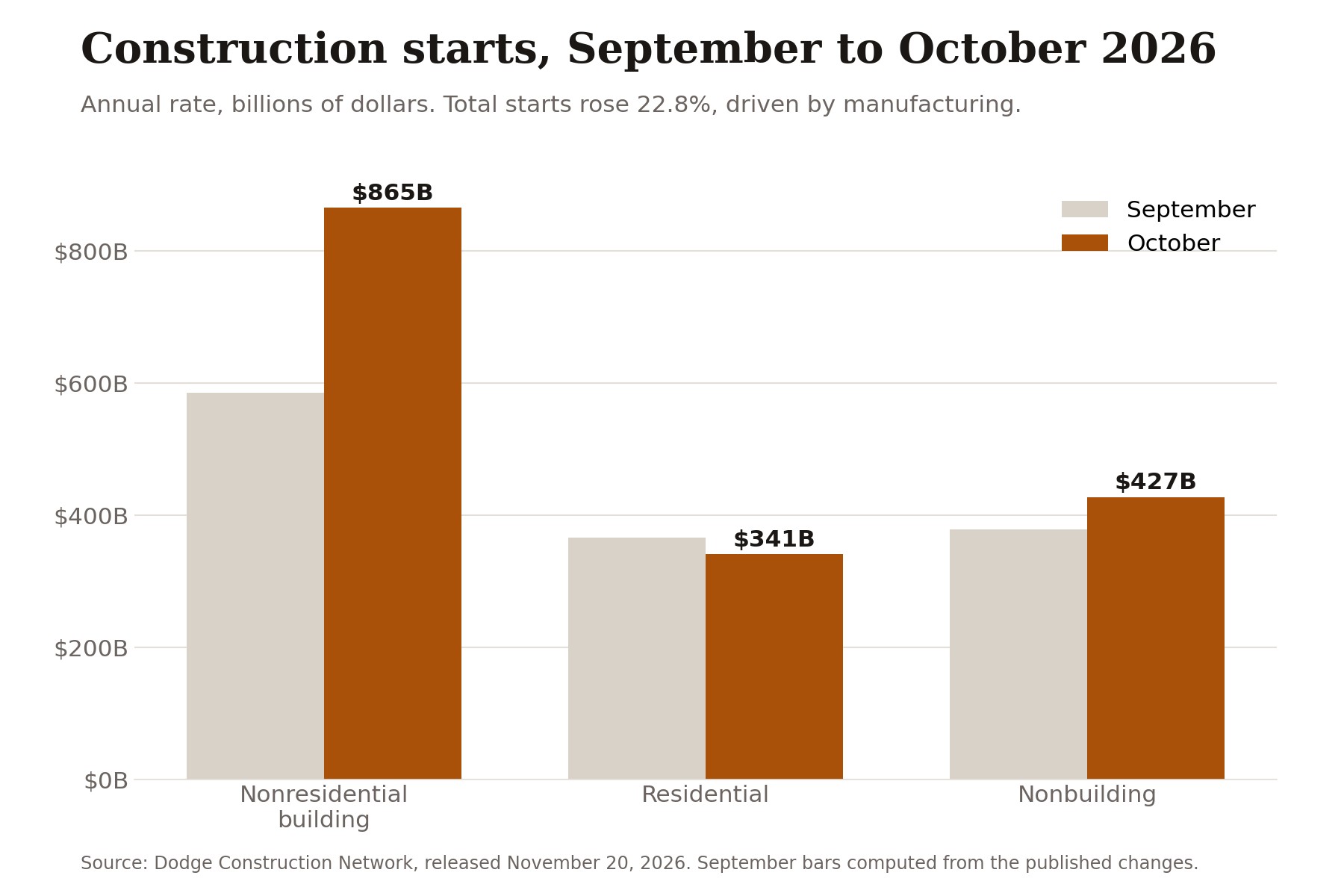
- Nonresidential building starts rose 47.7% to $865 billion. Healthcare rose 50.1%, warehouses 7.3%. Offices fell 7.3%, their fourth straight monthly drop. Education fell 4.9%.
- Residential starts fell 6.9% to $341 billion. Multifamily dropped 14.8% in the month but is up 7.8% over 12 months. Single family is down 7.3% over 12 months.
- Nonbuilding work, such as infrastructure and utilities, rose 12.9% to $427 billion.
- Through October, total starts are up 14.6% for the year and nonresidential building is up 30.0%.
Spending: what is being built now (Census)
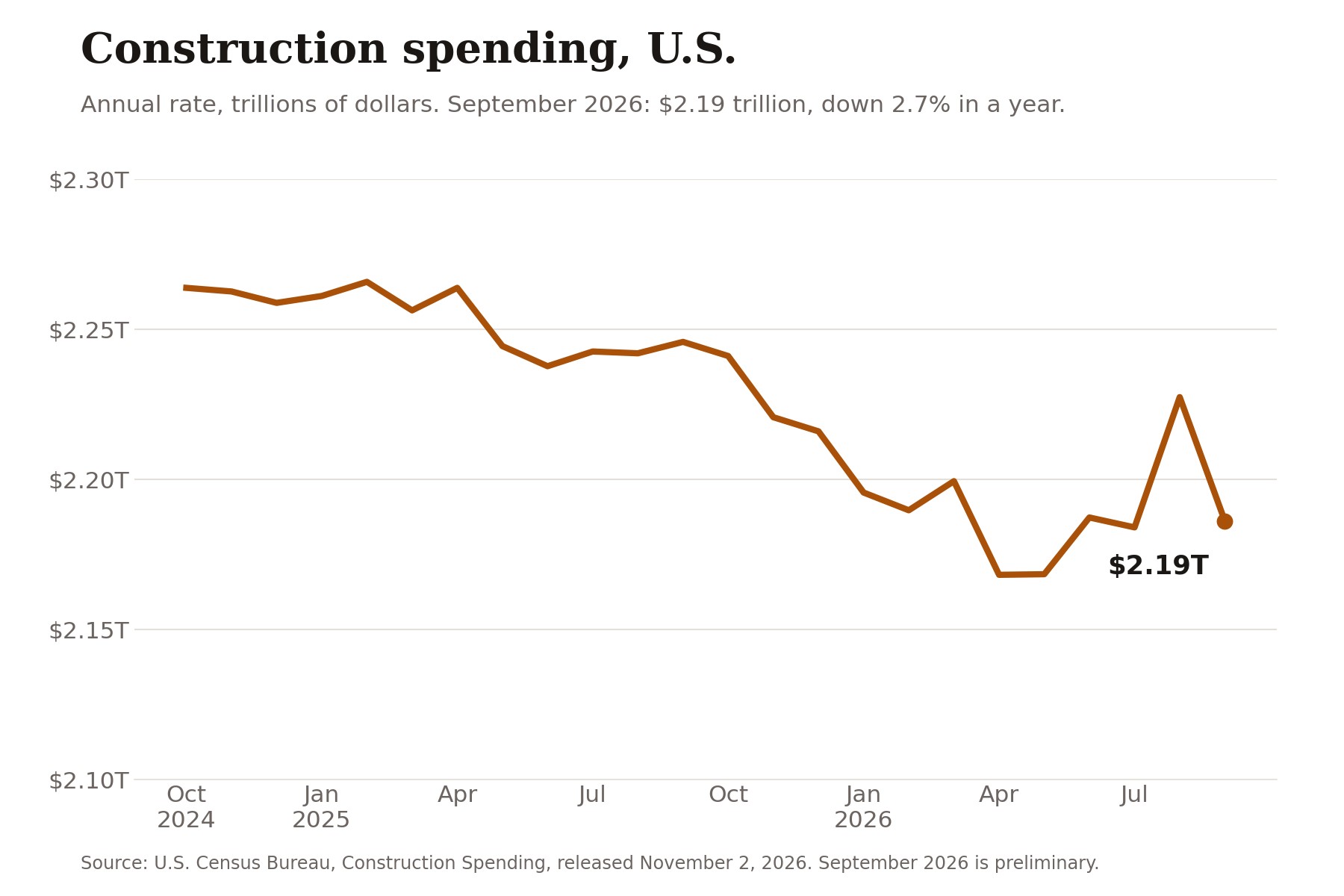
The Census Bureau puts September construction spending at a $2.186 trillion annual rate. That is down 1.9% from August and 2.7% from September 2025. Spending for the first nine months of 2026 is down 2.9% from the same months of 2025.
- Private residential: $848.8 billion, down 5.5% in the month and 8.9% in a year. Housing is the main reason the total is lower.
- Private nonresidential: $790.6 billion, up 1.1% in the month and 2.3% in a year. Office spending is up 39.5% from a year earlier and power is up 12.1%. Manufacturing spending is down 17.9%.
- Public: $546.8 billion, nearly flat in the month and up 1.0% in a year.
October spending has not been released yet. The Census figures are revised for months afterward, so treat the September number as a first estimate.
Jobs: who is doing the work (BLS)
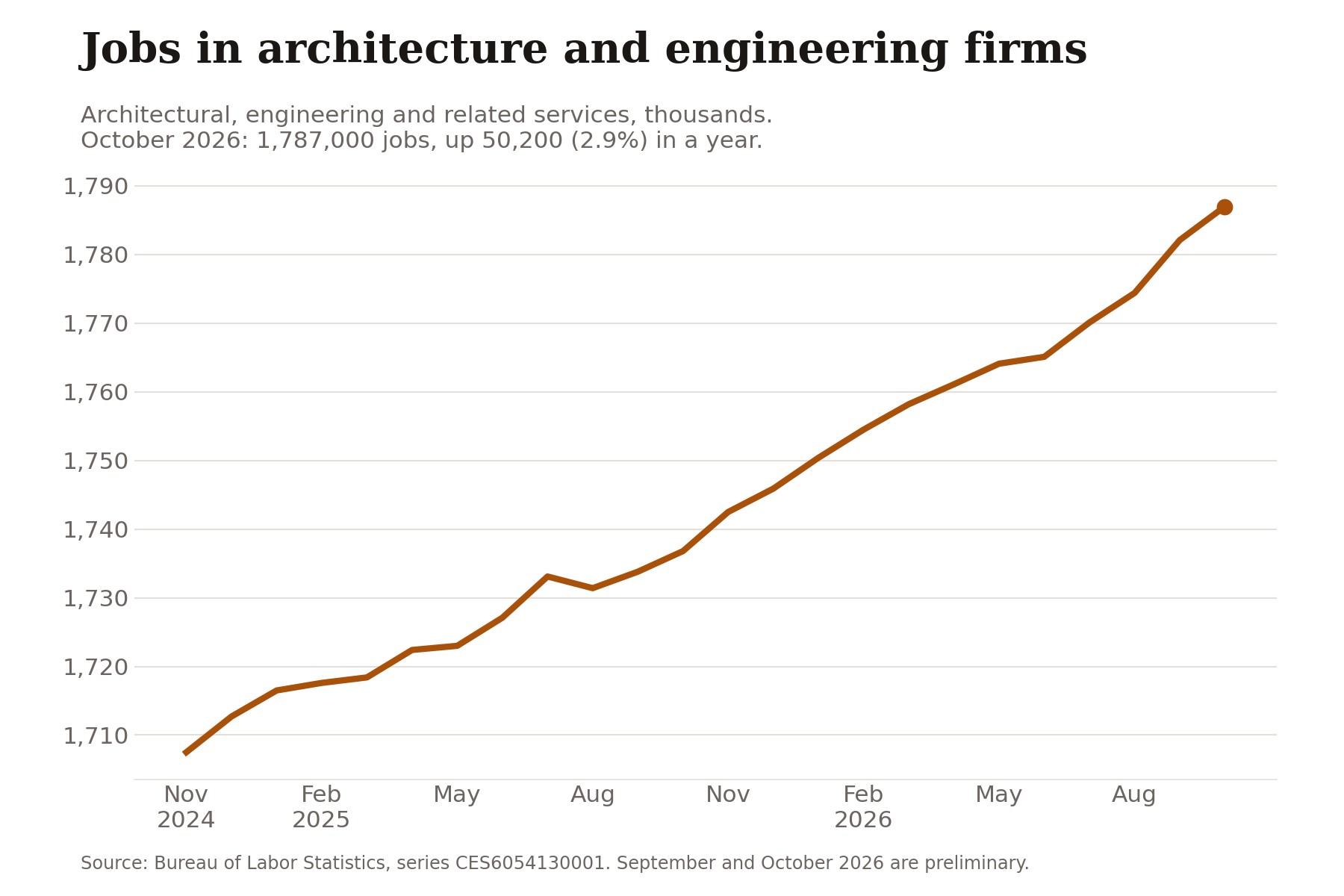
Employment at architectural, engineering and related services firms reached 1,787,000 in October, up 4,900 from September and 50,200 (2.9%) from a year earlier. The line has climbed nearly every month for two years.
- The narrower architectural services series, which runs a month behind, was 204,400 in September. That is about level with August and down 300 from a year earlier, so the growth in the broader series is mostly at engineering and related firms.
- Construction employment was 8,367,000 in October, down 3,000 in the month and up 124,000 in a year.
- September and October figures are preliminary and will be revised.
What it means for a small or mid-size firm
- Public and institutional clients look steadier than commercial ones for 2027. Schools, healthcare and civic work are where planning is still growing.
- Commercial planning is falling, including data centers and warehouses, so firms that lean on those clients should watch their 2027 pipeline closely.
- Housing spending is lower than a year ago, even though multifamily starts are up over 12 months. Residential firms are likely to see uneven demand.
- A/E firms added 50,200 jobs in a year, so experienced staff are in demand. Plan pay and retention for 2027 with that in mind.
ALA will update these numbers as each source releases new data.